
I had a dynamic electricity tariff in Vienna for more than a year, a spot tariff (Spottarif, Floater) where the price changes every quarter hour with the EPEX day-ahead exchange price. My water boiler, dishwasher and washing machine run in the cheapest window of the day, and that works. Still, for winter 2026/27 I am switching to a fixed price (Fixpreis) of 9.99 ct/kWh. The EEX futures for Austria say this winter will be expensive, and a calculation with my own consumption data shows the fixed price about 265 EUR cheaper over the next 12 months.
In short (data as of 26 October 2026):
- Dynamic tariff with smart load shifting, last 12 months: 11.18 ct/kWh net, the same total cost as a fixed price of 9.99 ct/kWh.
- EEX futures for Austria, November 2026 to February 2027: 25 to 26 ct/kWh, about twice last winter.
- Expected cost for the next 12 months at 3323 kWh: 599 EUR net dynamic, 392 EUR net fixed.
- Result: the fixed price is about 206 EUR net or 265 EUR gross cheaper. The dynamic tariff only wins in April and May.
In German the question is “Floater oder Fixpreis?”, and the answer for the Strompreis in winter 2026/27 is the same: Fixpreis.
How much the automation saved with the dynamic tariff
From 24 October 2025 to 24 October 2026 I drew 3323 kWh from the grid. With the spot price plus the 1.30 ct markup of my supplier, the average over all quarter hours of the year was 13.86 ct/kWh. Weighted by when I actually drew the power, I paid 11.18 ct/kWh. That gap is what the cheapest windows from the post about heating water when electricity is cheap bring, about 89 EUR net in a year.
Most of it comes from spring and summer. In May I paid only 49 % of the average price of the month, because the boiler heats at noon, when the balcony solar panels and the low exchange price help at the same time. In December it was 96 %. There is not much to shift when the sun is gone and the cheap hours are at night.
The fixed price offer in Vienna
Wien Energie currently sells a fixed price of 9.99 ct/kWh net (12.83 ct with the Vienna usage levy and VAT) for 12 months, with a base fee of 6.44 EUR a month. Grid fees (Wiener Netze), the summer grid tariff SNAP and taxes are the same with every supplier, so only the energy price and the base fee count in the comparison.
Over the last 12 months both tariffs would have cost me almost exactly the same: 393 EUR net with the dynamic tariff, 392 EUR with the fixed price. The automation made the dynamic tariff as cheap as the best fixed price. It did not beat it.
Electricity price forecast for Austria: the futures for winter 2026/27
The past year does not tell much about the next one. The futures do. They are the prices traders pay today for power delivered later, and the EEX publishes a settlement price for every month, quarter and year. Austrian base load, on 26 October 2026:
| Delivery | EUR/MWh | ct/kWh |
|---|---|---|
| November 2026 | 261.99 | 26.2 |
| December 2026 | 252.36 | 25.2 |
| January 2027 | 259.96 | 26.0 |
| February 2027 | 250.25 | 25.0 |
| March 2027 | 201.16 | 20.1 |
| April 2027 | 148.87 | 14.9 |
| May 2027 | 125.55 | 12.6 |
| Q2 2027 | 134.35 | 13.4 |
| Q3 2027 | 151.31 | 15.1 |
| Q4 2027 | 175.68 | 17.6 |
Last winter the exchange price was between 12 and 15 ct/kWh. A month ago the November contract was still at 193 EUR/MWh. It went up by a third since then.
Dynamic vs. fixed price: the calculation with my own data
A small Python script takes my grid import and my shifting factor per month from InfluxDB. The shifting factor is the price I paid divided by the average price of that month. Both go onto the futures plus the markup. That assumes I use about as much power as last year and shift it as well as last year.
| Month | kWh | Futures ct | I would pay ct | Dynamic EUR | Fixed EUR |
|---|---|---|---|---|---|
| Nov | 294 | 26.2 | 24.9 | 73.0 | 29.3 |
| Dec | 373 | 25.2 | 25.6 | 95.4 | 37.2 |
| Jan | 363 | 26.0 | 24.8 | 90.0 | 36.3 |
| Feb | 294 | 25.0 | 24.6 | 72.2 | 29.3 |
| Mar | 308 | 20.1 | 15.4 | 47.3 | 30.8 |
| Apr | 248 | 14.9 | 8.5 | 21.1 | 24.8 |
| May | 249 | 12.6 | 6.8 | 16.9 | 24.9 |
| Jun | 269 | 12.9 | 10.7 | 28.8 | 26.8 |
| Jul | 241 | 15.1 | 13.0 | 31.3 | 24.1 |
| Aug | 251 | 15.1 | 13.7 | 34.3 | 25.1 |
| Sep | 156 | 15.1 | 13.2 | 20.7 | 15.6 |
| Oct | 278 | 17.6 | 16.6 | 46.1 | 27.7 |
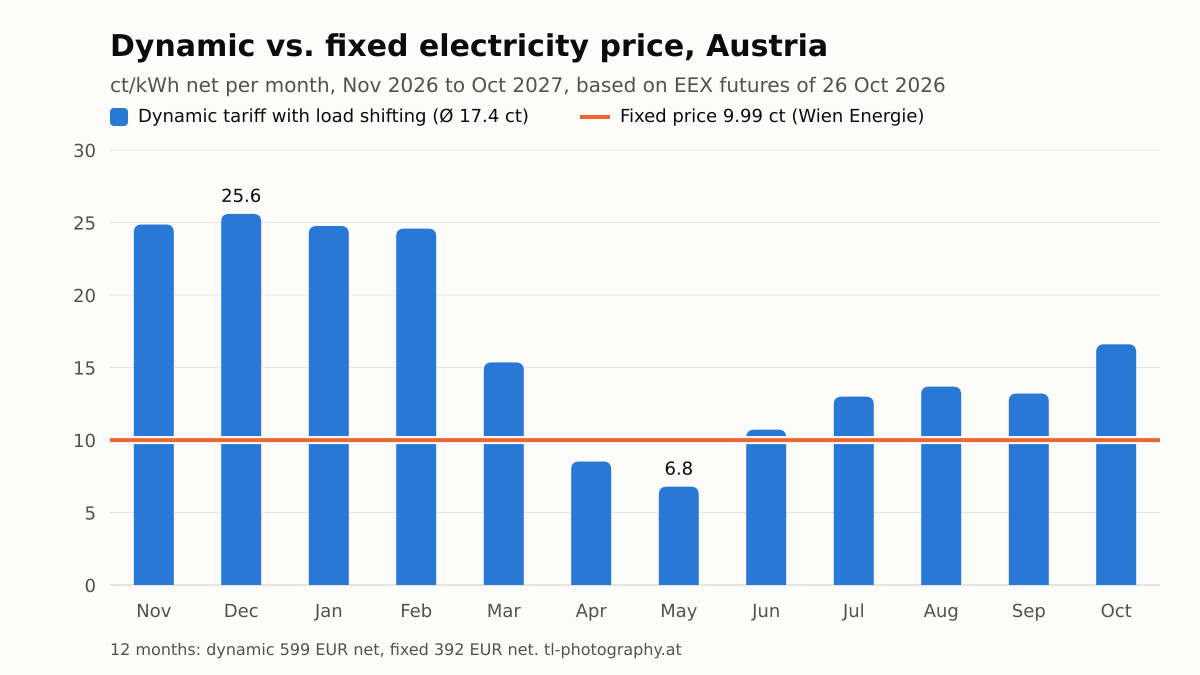
June comes from the quarter minus April and May, July to October from the quarters. With the base fees the dynamic tariff ends at 599 EUR net, the fixed price at 392 EUR. That is 206 EUR net, or 265 EUR with levy and VAT, in favour of the fixed price.
The dynamic tariff only wins in April and May, by 12 EUR together. November to February alone cost almost 200 EUR more. Smart load shifting pushes the price below the average of the month, but not below a fixed price that is less than half of the futures.
Could the dynamic tariff still win?
Sure. Futures are what the market expects today, not what will happen. A mild and windy winter can end well below these numbers. But the gap would have to shrink by more than two thirds before the dynamic tariff catches up, and the risk sits exactly in the months where I use the most.
The 9.99 ct is also a discount for new customers in the first year, and the offer is only valid for a contract start in October 2026. After the 12 months I will run the same script again with the futures of next autumn.
What happens to the smart home automation with a fixed price
It stays. With a fixed price the boiler window should not look for the cheapest price anymore, but for the solar surplus. I get nothing for power I feed into the grid, so every kWh the boiler takes from the panels saves the full price. The optimalwindow rule in openHAB can do that with the PV forecast as forecast item instead of the price.
Peak shaving does not care about the tariff at all. It is about the highest quarter hour, and that matters with any supplier once the grid operator charges for it, see peak shaving with the water boiler. And the summer grid tariff from the SNAP post is a grid fee, so it stays as well.
FAQ
Is a dynamic electricity tariff worth it in Austria?
It depends on the futures and on how much you can shift. Over the last 12 months my dynamic tariff with automation cost the same as the best fixed price. For winter 2026/27 the futures are so high that the fixed price wins by about 265 EUR, even with load shifting.
How do I compare a spot tariff with a fixed price?
Take your grid import per month, how much below the monthly average you usually pay, and the EEX futures for each month. Add the markup of the spot supplier and the base fees. Grid fees and taxes can be left out, they are the same for both.
Will electricity get more expensive in Austria in 2027?
The wholesale part does, at least in winter. The EEX futures for January 2027 are at 26 ct/kWh, against 12 to 15 ct last winter. From April the futures drop to 13 to 15 ct. Grid fees and taxes come on top and are not part of the futures.
Where do I find the electricity futures for Austria?
The EEX Market Data Hub shows the settlement prices of the Austrian power futures (Phelix AT) per month, quarter and year. The Austrian Energy Agency publishes the ÖSPI once a month, an index built from the same futures.
When does a dynamic tariff pay off again?
When the futures for the winter are back near or below the fixed price. Next autumn I compare again. If the winter futures are back below 10 ct/kWh, the dynamic tariff is back too.